
Confirmed Lisle Directory Collections
The verified Lisle city directory years cluster in the 1920s. They are regional volumes, not a seamless municipal series. Each holding below has an institutional source. Access notes distinguish a public scan from a shelf locator, because a catalog listing does not guarantee that every page is downloadable.
| Collection | Years | Where held | Access |
|---|---|---|---|
| Naperville, Lisle and Eola City Directory | 1923–24 | Naper Settlement | Research shelf or staff inquiry |
| McDonough DuPage County directory | 1924–25 | Naper Settlement | Inspect in person |
| DuPage County Directory | 1925–26 | Illinois Digital Archives | Free page-image scan |
| Lisle under DuPage County | 1925–28 | Newberry Library list | Confirm volume and shelf access |
| Naperville telephone directories | 1909–60 | Naper Settlement | Nearby-region cross-check |
| Lisle Sun selection | 1940s onward | Lisle Library | Microfilm and staff help |
| Reverse or criss-cross run | Not verified | Ask local and regional repositories | No published continuous run |
Missing years should remain gaps. The Newberry list places Lisle under DuPage County from 1925 through 1928, but it does not prove that each year is a distinct online volume. Contact the holding library before planning a visit.
Open Lisle's 1925 Directory Scan
The Illinois Digital Archives item is a public-domain scan of McDonough & Co.'s 1925–26 DuPage County Directory. Naper Settlement is the publisher or host named in its metadata, and Naperville Public Library contributed the 1,188-page object. Its description lists Lisle among many DuPage places, says residents are listed by city, and also notes a rural section.
The successful capture shows the compound-item record used to open the page images.
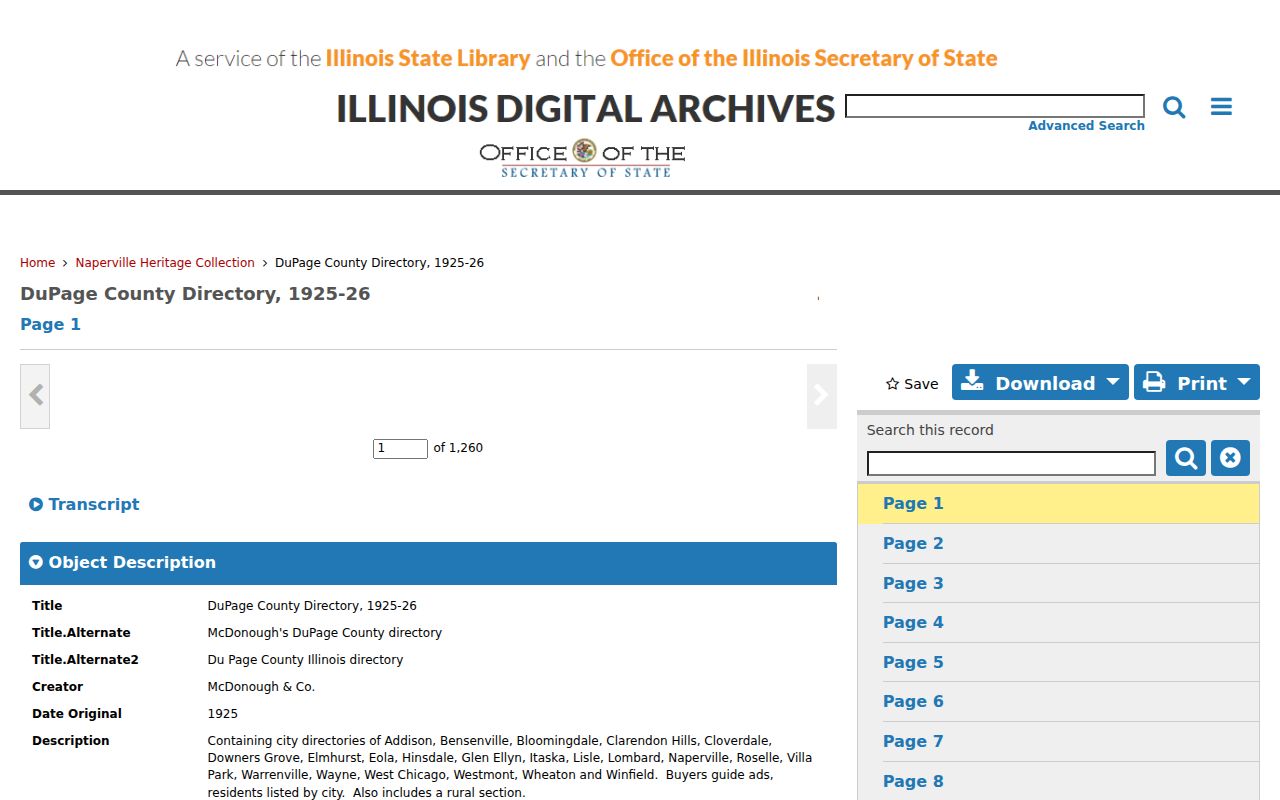
Page records expose a page number, image identifier, thumbnail and download links rather than a clean text transcript. Browse the Lisle heading and rural pages. Record the page and section with every name. OCR was not reliable enough during research to publish a sample person, so entries must be transcribed from the image.
Insider tip. A person missing from the Lisle heading may still appear in the volume's rural section or under a nearby place label.
Read a Lisle Directory Entry
Start with the abbreviation key printed in that exact volume. Directory conventions vary by publisher, and research did not verify a Lisle leaf clearly enough to claim a local symbol. Preserve initials, suffixes, punctuation and spelling. Do not modernize the street name before saving the printed form.
| Name | Copy the exact surname, given name or initials and any suffix. |
|---|---|
| Place section | Note Lisle, rural, township or neighboring-place heading. |
| Address | Retain the printed street, number and route wording. |
| Work line | Record any occupation or business exactly as printed. |
| Telephone | Keep the number or exchange notation if present. |
| Citation | Save volume title, year, page, repository and image link. |
Only claim fields actually visible on the page. A missing address may reflect publication practice, an unlisted person or an unreadable scan. It does not prove that the household was absent from Lisle.
- Criss-cross directory
- A directory arranged by street or phone number instead of only by surname.
- Householder index
- An address-oriented list of named household heads, when a volume includes one.
- Abbreviation key
- The publisher's own legend for shortened words and marks.
- Page image
- A scan of the printed leaf, which should control over imperfect OCR.
Why Lisle Names Shift Labels
DuPage County was organized in 1839. Naperville and Wheaton served as county seats until 1867, after which Wheaton remained the seat. Lisle Township was called DuPage Township until November 13, 1850. Those facts matter when a land, census or city directory record uses an older jurisdiction label.
The 1923–24 volume joins Naperville, Lisle and Eola in one title. The 1925–26 book is countywide and has both city and rural arrangements. Test Lisle, DuPage County, rural, Eola, Naperville and the relevant township without silently changing what the source says. Modern Village, postal, library district and ZIP boundaries cannot simply be imposed on an early entry.
Note: Preserve an old place label in the citation, then explain its present-day relationship separately.
Lisle Library's History Layers
The Lisle Library Local History collection offers books, historical maps and selected Lisle Sun microfilm dating to the 1940s. The page also routes researchers to Illinois Digital Heritage Hub material, including postcards, city directories, newspapers and photos associated with Lisle Library District. Adult Services can be reached at adultservices@lislelibrary.org; the library is at 777 Front Street and its main phone is 630-971-1675.
Database access differs. Ancestry Library Edition is available inside the library and covers directories, census, military, land, probate, vital, church and passenger records. HeritageQuest is described as remotely available to cardholders with a card number and PIN. It includes federal census images from 1790 through 1950 plus family histories and other collections.
| Resource | Use with directory evidence | Access |
|---|---|---|
| Ancestry Library Edition | Repeat surname, census and land searches | Library terminal |
| HeritageQuest | Open census images and local histories | Remote for cardholders |
| Lisle Sun | Find dated obituaries and announcements | Library microfilm |
| Digital Heritage Hub | Browse maps, photos and directory pages | Online partner search |
The library district includes most of the Village plus unincorporated Four Lakes, Woodridge Estates, The Meadows and part of unincorporated Naperville including Steeple Run. Card eligibility and Village residence are therefore not identical questions.
Lisle Directory Research Counters
Several repositories fill different gaps. Naper Settlement Research Materials is the clearest source for the 1923–24 and 1924–25 directories, as well as telephone books, plat material and listed DuPage census years. Ask staff for the exact volume, call number and rules before visiting.
The DuPage County Historical Museum research library has public library and vertical-file holdings during museum hours, with archives by appointment. Its materials include city directories, newspapers, maps, platbooks, genealogies, photographs, organization records, oral histories, real-estate files and land-sales references.
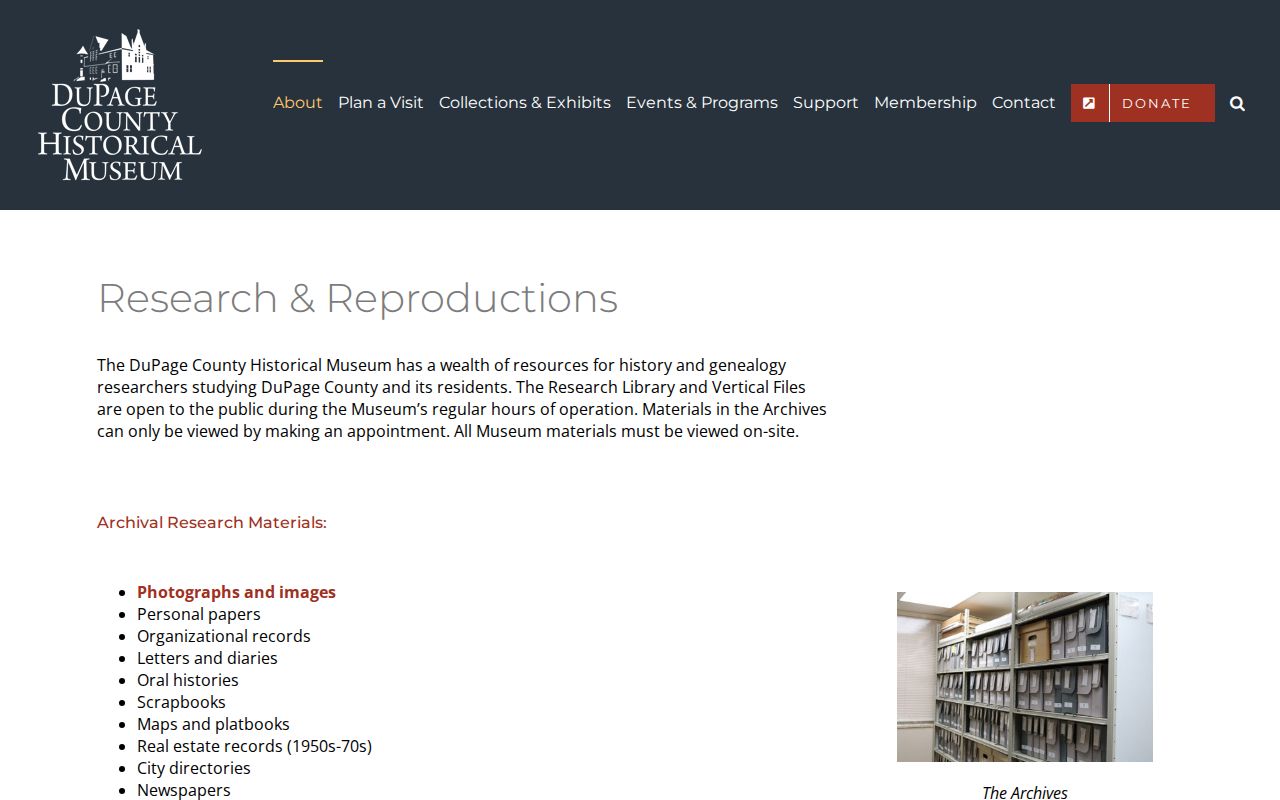
The image shows the museum's research route, which is useful when a city directory scan needs a map, clipping or real-estate file beside it. Newberry serves as a holdings locator for 1925–28, while IRAD DuPage points toward land, marriage, death and local-government series. Use phone, email, appointment, on-site and mail channels as each repository allows.
Test Lisle Entries in Newspapers
A directory entry identifies a printed name in a stated year. A newspaper can add a dated obituary, sale, school, club or civic reference. Lisle Library's microfilm is the most local verified route, and its historical newspaper databases include the Chicago Tribune from 1849–1993 and the Chicago Defender from 1910–1975. Save the title, date and page.
Newspaper evidence is not a vital certificate. Confirm the identity through relatives, age, address, cemetery, probate or an eligible official record. No separate public Lisle obituary index was verified, so ask Adult Services about the right reel or database instead of citing an invented index.
Lisle Directory Evidence Through Time
Lisle household research crosses several record eras. The sequence shows why one search box cannot replace the shelves.
| Period | Lisle evidence milestone |
|---|---|
| 1839 | DuPage County organized; older county land and local records begin their own series. |
| 1850 | DuPage Township renamed Lisle Township. |
| 1923–24 | Confirmed Naperville, Lisle and Eola directory. |
| 1924–28 | Verified countywide McDonough and Newberry-listed Lisle holdings. |
| 1940s onward | Selected Lisle Sun microfilm supplies local event context. |
| 1961 onward | Recorder online name index and images add a modern land-record bridge. |
No official courthouse disaster or continuous Polk run was found. Use these known cutovers and repository catalogs instead of repeating an unsupported story about missing Lisle records.
Trace Families in Lisle Directories
A careful family-history search treats every printed year as one observation. Move forward and backward, and look for the same household in census, newspaper, land and cemetery evidence. A changed initial, street spelling or place label may be a catalog issue rather than a different person.
- Choose a verified volume and record its full title, publisher, year and repository.
- Browse the surname section, then inspect Lisle and rural pages instead of relying only on OCR.
- Transcribe the entry and abbreviation key exactly, including page and section.
- Compare census images for the same household, township and nearby names.
- Search newspaper microfilm for a dated event and land records for the address or party.
- Ask a repository for the next available year when the known run has a gap.
Disappearance from a city directory can mean a move, death, omission, new spelling or a shift to a rural section. The early-settler trail offers a concrete extension: the Village names five of Lisle Cemetery's first eleven 1830s settlers, but the inspected page has no searchable burial database. Call the Village or cemetery, then test the surname in IRAD land records, census holdings and local news.
Limits of Lisle City Directories
A printed directory is neither a complete census nor proof of a person's legal residence. Coverage may omit rural households, children, unlisted numbers or people missed by the publisher. A telephone directory is not automatically a city directory, and nearby Naperville coverage does not guarantee Lisle inclusion.
State the year, page, place heading and repository with every conclusion. Verify claims against an original image or shelf copy. For modern address-keyed property work, the Lisle street directory follows assessor, GIS and Recorder sources without turning those owner records into historical household lists.